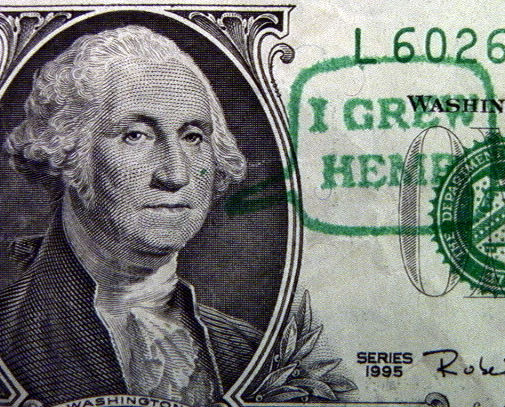
HEMP CAN HONESTLY SAVE THE WORLD!!
Hemp... It can make us just about anything------except high!
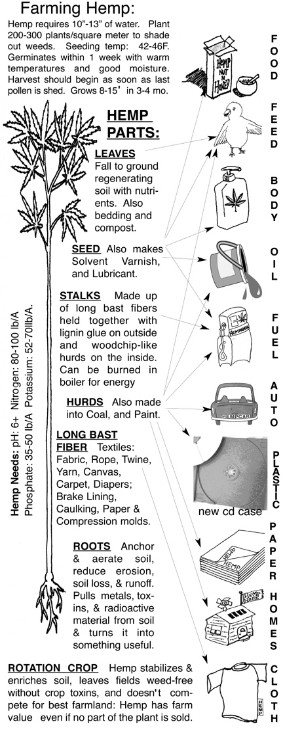
Food: Hemp seed provides nearly complete nutrition with all 10 essential amino acids, all 4 essential fatty acids (EFAs) in the ratio recommended by health experts, and over 30% protein in its most easily digestible forms, making hemp the ideal protein, and ideal food for human consumption.
Feed: Hemp meal provides all the essential protein that livestock require, yet doesn't require any antibiotics to digest. When cows eat corn they cannot digest it, needing antibiotics to keep from being sick, which makes the antibiotics less effective on the humans that consume the beef. Hemp is also an excellent animal bedding for horses.
Body Care: Because of hemp oils high EFA content, especially GLA, hemp helps cells to communicate to rebuild cell membranes, which keeps the skin from getting dry by enabling skin cells to hold onto moisture in their natural lipid layers.
Oil: Hemp oil can be made into non-toxic paints, varnishes, lubricants, and sealants. The paints last longer, and the sealants are better absorbed by wood.
Fuel: Hemp biomass can produce electricity from sulfur-free charcoal, as well as ethanol, yet these industries will be the last to develop due to the high value of hemp food. Hemp can easily be made into biodiesel fuel as well.
Cars: European plants are making auto panels from hemp based composites that are biodegradable, half the weight of, more durable, and safer than fiberglass counterparts. For example, every Mercedes car uses 35.2 pounds of hemp panelling!
Plastics: Hemp hurds and fiber have over 50% cellulose, the building blocks of plastics. Biodegradable hemp plastics could reduce landfill waste and display unique strength characteristics. Oil based plastics produce biproducts of sulfur and carbon monoxide and do not biodegrade.
Paper: Hemp pulp paper doesn't require toxic bleaching chemicals and lasts hundreds of years longer than paper made from trees. It is stronger, and can be recycled many more times than tree paper. An acre of hemp can produce as much pulp as an acre of trees over a 20 year growing cycle!
Homes: Hempcrete homes, a mixture of hemp and lime, are fire, water, and rodent proof, with excellent elasticity, strength and breathability, which cuts energy costs. Washington State Univ. found hemp board to be three times stronger than plywood.
Clothes: Hemp is among the longest, strongest, most elastic, and most durable fibers in nature. Hemp is stronger, more durable, softer, more UV protective, warmer, and won't mildew or rot like cotton fiber, which requires 25% of the worlds crop chemicals.

US GOVERNMENT LIES AND THE PEOPLE INVOLVED IN CHANGING HISTORY FOR THE WORST
1920-1940: Economic power is consolidated in hands of small number of steel, oil and munitions companies, such as Dupont, which became the US's primary munitions manufacturer. Dupont developed and patented fuel additives such as tetraethyl lead and other petroleum based products like nylon, cellophane and plastics during this time. Mexican rebels seize prime timberland from land belonging to newspaper magnate, paper and timber baron, William Randolph Hearst.
1920-1970: Oil Barons Rockefeller, Standard Oil, and Rothschild of Shell, etc., realized the possibilities of Henry Ford's vision of cheap methanol fuel, so they kept oil prices at between one dollar and four dollars a barrel (almost 42 gallons in a barrel), so that no other energy source could compete with it, until 1970, after all competition was erased, when the price of oil jumped to almost $40/barrol over the next 10 years.
1931: Andrew Mellon, The Treasury Secretary, and Head of Bank of Pittsburgh, which loaned Dupont 80% of its money, appoints his niece's husband, Harry J. Anslinger, to head newly formed Federal Bureau of Narcotics (later becoming the DEA).
1930s: Following action by the Federal Bureau of Narcotics and a campaign by William Randolph Hearst, propaganda is created against hemp from companies with vested interest in the new petroleum-based synthetic textiles. Even though hemp reinvented itself, thanks to new technology that eased processing and expanded its use, the timber (Hearst) and oil interests (Dupont, Anslinger, Mellon) crushed competition from plant-based cellulose by demonizing marijuana, and paralleling its use to Mexican immigrants and later Black jazz musicians. The effects of marijuana are demonized with such movies as "Marijuana: assassin of youth," Devil's weed," and "Reefer Madness." Throughout this assault hemp's link to marijuana is exaggerated.
1937: DuPont Corporation patents processes for making plastics from oil and coal. The Marijuana Tax Act is passed, a prohibitive tax on hemp in the USA, effectively destroying the industry. Anslinger testifies to congress that 'Marijuana' is the most violence causing drug known to man. The objections by the American Medical Association (The AMA only realized that 'Marijuana' was in fact Cannabis or Hemp two days before the start of hearing) and the National Oil Seed Institute are rejected.
1937 - late 60s: US government understood and acknowledged that Industrial Hemp and marijuana were not the same plant.
1938: Popular Mechanics magazine, nearly at the same time as the Marijuana tax act goes into effect, touts hemp as first "billion dollar crop" and lists over 25,000 uses.
In 1938: Canada prohibits marijuana, and thus hemp production, under the Opium and Narcotics Control Act.
1940: World production of hemp peaked at about 832,000 tons of fiber.
1941: Popular Mechanics Magazine reveals details of Henry Ford's plastic car made using hemp and fueled from hemp. Henry Ford continued to illegally grow hemp for some years after the Federal ban, hoping to become independent of the petroleum industry.
1941-1945: Hemp for Victory
During World War II, Japan cut off our supplies of vital hemp and coarse fibers. The hemp was needed for making, among other things, rope, webbing, and canvas, to be used on navy ships. So a program was started to grow hemp for military use under the banner of "Hemp For Victory". After the war, licenses were subsequently revoked; concurrent with the last hemp crops being grown in the U.K.
The U. S. Department of Agriculture released an educational film called "Hemp for Victory", which showed farmers how to grow and harvest industrial hemp. Hemp harvesting machinery was made available at low or no cost. From 1942 to 1945, farmers who agreed to grow hemp were waived from serving in the military, along with their sons; that's how vitally important hemp was to America during World War II. The fields of hemp were termed victory gardens, as were the backyard vegetable gardens also urged by the government.
1942: Patriotic farmers plant 36,000 acres of seed hemp, an increase of several thousand percent from the previous year.
1943: Both the US and German governments urge their patriotic farmers to grow hemp for the war effort. The US shows farmers a short film - 'Hemp for Victory' which the government later pretends never existed. The United States government has published numerous reports and other documents on hemp dating back to the beginnings of our country.
1945: The war ends and so does "Hemp for Victory". Feral hemp, "ditch weed", still lines the back roads, waterways, and irrigation ditches of most Midwestern states, 60 years descended from "Hemp for Victory!"
1961: UN treaty allows for the cultivation of industrial hemp.
1968: The last legal hemp crop is grown in Minnesota
Cannabis Timeline
2737 BC: Cannabis referred to as a "superior" herb in the world's first medical text, or pharmacopoeia, Shen Nung's Pen Ts'ao, in China
1500 BC : Cannabis-smoking Scythians sweep through Europe and Asia, settling and inventing the scythe.
1400 BC : Cultural and religious use of ganga or cannabis, and charas or hashish (resin) recorded used by Hindus in India.
c30 AD : Jesus teaches :Not that which goeth into the mouth defileth a man; but that which cometh out of the mouth, this defileth a man (Matthew 15:11).
70 AD : Roman Emperor Nero's surgeon, Dioscorides, praises cannabis for making the stoutest cords and for its medicinal properties.
100 AD : Roman surgeon Dioscorides names the plant cannabis sativa and describes various medicinal uses. Pliny reported of industrial uses and wrote a manual on farming hemp.
400 AD : Cannabis cultivated for the first time in the UK at Old Buckenham Mere
800 AD : Mohammed allows cannabis but forbids the use of alcohol.
1563 AD : English Queen Elizabeth I decrees that land owners with more than 60 acres must grow hemp or be fined 5 pounds.
1621 AD : The Anatomy of Melancholy claims cannabis is a treatment for depression.
1637 AD : The General Court at Hartford, Conneticut, orders that all families plant one teaspoon of cannabis seeds.
1763 AD : New English Dictionary says cannabis root applied to skin eases inflammation.
1776 AD : Declaration of Independence drafted on hemp paper.
1791 AD : President Washington sets duties on hemp to encourage domestic industry. "Make the most of the Indian Hemp Seed" ........President George Washington. (Library of USA Congress 1794 vol. 33 p.270). President Jefferson calls hemp a necessity and urges farmers to grow hemp instead of tobacco.
1845 AD : Psychologist and inventor of modern psychopharmacology and psychotimimetric drug treatment, Jacques-Joseph Moreau de Tours documents physical and mental benefits of cannabis.
1860 AD : First governmental commission study of cannabis and hashish conducted by Ohio State Medical Society. It catalogues the conditions for which cannabis is beneficial: neuralgia, nervous rheumatism, mania, whooping cough, asthma, chronic bronchitis, muscular spasms, epilepsy, infantile convulsions, palsy, uterine hemorrhage, dysmenorrhea, hysteria, alcohol withdrawal and loss of appetite.
1870 AD : Cannabis listed in US Pharmacopoeia as a medicine.
1876 AD : Hashish served at American Centennial Exposition.
1930 AD : Henry Ford makes his motor cars out of hemp with hemp paint and hemp fuel. New machines invented to break hemp, process the fibre and convert the pulp or hurds into paper, plastics etc. 1200 hash bars in New York City. Racist fears of Mexicans, Asians and African-Americans lead the cry for cannabis to be outlawed.
1941 AD : Henry Ford's car runs on cannabis.
1962 AD : President Kennedy using cannabis as a pain relief.
1964 AD : THC, tetrahydracannabinol, first isolated
1967 AD : SOMA Times Petition in the UK urges legalisation of cannabis. The Beatles sign it. 3,000 people hold a 'smoke-in' in Hyde Park.. Keith Richards and Mick Jagger of the Rolling Stones are arrested and imprisoned for cannabis. This prompts a Times editorial 'Who breaks a butterfly on a wheel?'. The convictions are quashed on appeal.. In the UK 2,393 persons arrested for cannabis offences.. In the USA over 3,000 joints mailed to addresses at random by Abbie Hoffman and the Yippies.
1968 AD : Campaign to stop US soldiers in Vietnam from taking cannabis - they switch to heroin.
1975 AD : Jamaica Studies reveal good health amongst prolific cannabis users. "No impairment of physiological, sensory and perceptual performance, tests of concept formation, abstracting ability, and cognitive style, and tests of memory."
1976 AD : USA New York Times (Jan 5) declares 'Scientists find nothing really harmful about pot'.
1976 AD : DuPont declares cannabis is less harmful than alcohol or tobacco and calls for its decriminalisation.
1977 AD : President Carter thinks cannabis should be legalised.
1981 AD : The Coptic Study claims 'No harm to human brain or intelligence' through cannabis use.
1987 AD : The USA Merck Manual of Diagnosis and Therapy says: "Cannabis can be used on an episodic but continual basis without evidence of social or psychic dysfunction. In many users the term dependence with its obvious connotations, probably is mis-applied... The chief opposition to the drug rests on a moral and political, and not toxicologic, foundation".
1988 AD : 6 September : DEA chief administrative judge, Judge Young, rules the US government should allow the medicinal use of cannabis. He says "Marijuana in its natural form, is one of the safest therapeutically active substance known to man". DEA rejects report.
1991 AD : THC receptors found in the brain.
1991 AD : UK 40,000 people arrested for cannabis.
1992 AD : "Medicines often produce side effects. Sometimes they are physically unpleasant. Cannabis too has discomforting side effects, but these are not physical they are political"... The Economist March 28th 1992
1992 AD : USA over 340,000 arrests for cannabis.
1992 AD : USA Jim Montgomery, a paraplegic who smoked cannabis to relieve muscle spasm, busted for two ounces of marijuana in Oklahoma, arrested and sentenced to life plus 16 years.
1993 AD : Over 72,000 UK citizens arrested for cannabis offences.
1995 AD : November 11 : British journal of the medical profession, The Lancet, states that 'The smoking of cannabis, even long term, is not harmful to health'.
1996 AD : A Swiss man, Zimmermann, is given a life sentence in the Maldives, for importing three cannabis seeds, found in his luggage as he flew in from India.
1996 AD : June : Scottish Nationalist conference votes to allow cultivation for personal use and research into medical uses of cannabis states "Relatively few adverse clinical effects from the chronic use of marijuana have been documented in humans. However, the criminalization of marijuana use may itself be a health hazard, since it may expose the users to violence and criminal activity."
1997 AD : An 8-year study at the University of California at Los Angeles (UCLA) School of Medicine, concluded that long-term smokers of cannabis do not experience a greater annual decline in lung functions than non-smokers.
Researchers said: "Findings from the present long-term follow-up study of heavy, habitual marijuana smokers argue against the concept that the continuing heavy use of marijuana is a significant factor for the development of [chronic lung disease]"
"No difference were noted between even quite heavy marijuana smoking and nonsmoking of marijuana."
Volume 155 of the American Journal of Respiratory and Clinical Care Medicine 1997
1997 AD : In the USA a $2 million study to prove cannabis smoking can cause cancer fails and announces that it does not. The release of the report is delayed due to 'lack of supplies'.
1998 AD : June 12: The UK Government has granted a license to grow and possess cannabis for the purposes of medical trials, to Dr Geoffrey Guy of GW Pharmaceuticals. The crop at a secret location in south-east England, is guarded by electrified razor-wire fences, security cameras and guard dogs.
1999 AD : March 21: USA: Government Study Labels Marijuana A Useful Medicine
2000 AD: May 6: Hundreds of thousands of people march for the end of the War on Cannabis
2000 AD: September 14: USA CA: Feds Rule Doctors May Recommend Pot
2000 AD: October 20: UK: Cannabis Less Harmful Than Aspirin, Says Scientist:
2000 AD: November 24: USA: CA: Study Of Pot's Benefits To AIDS Patients Gets DEA's Blessing
Timeline Courtesy of Toronto Hemp Company (THC) Thanks!
| |
|
Earliest History 10,000 BC: In Taiwan, the earliest-known hemp relic in existence. 8000 BC: In China, the earliest known cloth fabric is woven from hemp. 5500 BC: Earliest known depiction of hemp in existence from Kyushu Island, Japan 4500 BC: China: Hemp is used for rope and fishnets. 4000 BC: China uses hemp foods. c. 3500 BC: Hemp rope was used in the construction of the pyramids because its great strength was ideal for working with large blocks of stone. 2800 BC: China makes first rope from hemp fiber. 2800 BC: Lu Shi (500 AD) mentions an Emperor who taught people to use hemp at 2800 BC. 2700 BC: China: Hemp was used for fiber, oil, and as a medicine. Examples of each were purposefully left in tombs with bodies. 1200 BC: Hemp cloth found in tomb of Pharaoh Alchanaten at El amarona. Records of apothecary form the time of Ramses III suggest hemp's use for an ophthalmic prescription. c. 1100 BC: City of Carthage uses hemp to dominate Mediterranean Sea as hemp is used in ships, rope, and as medicine. 1000 BC: Hemp is cultivated in India. 650 BC: Hemp is mentioned in cuneiform tablets. 450 BC: Greek historian Herodus claims that "hemp garments are as fine as linen." From Asia to Afghanistan to Egypt, hemp was widely cultivated for its fiber. c. 400 BC: Buddha was nourished with hempseed. 300 BC: A Carthaginian galley sank near Sicily was found with hemp onboard that was still identifiable after 2,300 years of salt water exposure. 200 BC: Greek Moschion wrote of hemp ropes used in the flagship Syracusi, and other ships of the fleet of Hiero II. 2nd Century BC: Roman writer Pausanaius noted hemp was grown in Elide. 100 BC: Chinese make paper (oldest surviving piece) from hemp and mulberry. Europe (A.D.) 1st Century AD: Pliny recommends hemp from Alabanda, a city of Cairn, in Asia Minor as the best hemp. 1st Century AD: Lucius Columella writing during the time of Agustus put forward hemp cultivation methods. 70: Hemp cultivated for the first time in England. By 400, hemp was a well-established crop. 3rd Century: Sample of hemp paper with Sanskrit characters in India. 500-1000: Hemp cultivation spreads throughout Europe. 600: Germans, Franks, Vikings, etc. make paper, sails, rope, etc. from Hemp. 6th century: A hemp-reinforced bridge is built in France. The bridge actually petrified and is still strong today. 7th Century: First known mention of hemp as a medicine in work of Suskota in India. 716: Shoes are constructed from hemp. 850: Viking Ships used hemp for their sails, ropes, fishing nets, lines and caulking. 8th Century: Arabs capture Chinese craftsman and learn to make paper from hemp. 8th Century: Japan Princess Shotoku sponsored the first recorded printing in her country using hemp. Japan continued to use hemp throughout thier history. Shinto priests, and royal family wore special hempen clothes. 10th Century: A treatise on hunting by Syrian Sid Mohammed El Mangali records hemp's use for game netting, and hemp seeds for bird lime. Hemp was used in these times in the mid-east as food, lamp oil, paper and medicine. 1000: Europe introduces hemp butter. 1000: The English word 'Hempe' first listed in a dictionary. 1150: Moslems use Hemp to start Europe's first paper mill. Most paper is made from hemp for next 850 years. Middle Ages: Knights drank hemp beer. 1215: Magna Charta was printed on Hemp paper. 14-15th Century: Renaissance artists committed their masterpieces to hemp canvas. 1456: Guttenberg Bible printed on hemp paper. 1492: Hemp sails and ropes make Columbus's trip to America possible (other fibers would have decayed somewhere in mid-Atlantic). 1494: Hemp papermaking starts in England. 1535: Henry VIII passes an act stating that all landowners must sow 1/4 acre, or be fined. 1537: Hemp receives the name Cannabis Sativa, the scientific name that stands today. 1563: Queen Elizabeth I decrees that land owners with 60 acres or more must grow hemp or else face a £5 fine. 1564: King Philip of Spain follows lead of Queen Elizabeth and orders hemp to be grown throughout his Empire from modern-day Argentina to Oregon. 16th Century: Hemp has wide cultivation in Europe for its fiber and its seed, which was cooked with barley and other grains and eaten. c. 1600: Galileo's scientific observation notes written on hemp paper. 16th-18th Century: Hemp was a major fiber crop in Russia, Europe and North America. Ropes and sails were made of hemp because of its great strength and its resistance to rotting. Hemp's other historical uses were of course paper (bibles, government documents, bank notes) and textiles (paper, canvas), but also paint, printing inks, varnishes, and building materials. Hemp was a major crop until the 1920's, supplying the world with its main supply of food and fiber (80% of clothing was made from Hemp). 17th Century: Dutch Masters, such as Van Gogh and Rembrandt, painted on hemp canvas. In fact the word canvas derives from the word "cannabis". 1807: Napoleon signs a Treaty with Russia, which cuts off all legal Russian hemp trade with Britain. Then The Czar refuses to enforce the Treaty and turns a blind eye to Britain's illegal trade in Hemp. 1812 -- 24th June: Napoleon invades Russia aiming to put an end to Britain's main supply of Hemp. By the end of the year the Russian winter and army had destroyed most of Napoleon's invading forces. The Royal Navy depended on the Russian hemp to stay afloat during their war with the U.S., the War of 1812. The Americas 1545: Hemp was introduced into Chile, then in 1554 to Peru. 1606: French Botanist Louis Hebert planted the first hemp crop in North America in Port Royal, Acadia (present-day Nova Scotia). 1611: British start cultivating hemp in Virginia. 1631: Hemp used for bartering throughout American Colonies. 1619: It became illegal in Jamestown, Virginia not to grow hemp because it was such a vital resource. Massachusetts and Connecticut passed similar laws in 1631, and 1632. 17-18th Century: Hemp was legal tender in most of the Americas. It was even used to pay taxes, to encourage farmers to grow more, to ensure America's independence. 1715, 1726 and 1730: Pro-hemp acts were signed to cut European imports, to help the struggling colonies, who spun hemp cloth, and printed bibles and maps on hemp paper, drive for self-sufficiency. 1720 - 1870: Every township in Lancaster County Pennsylvania grew hemp, flourishing just before the Revolution. There were more than 100 mills that processed hemp fiber. 1775: Hemp was first grown in Kentucky. 18th Century: Benjamin Franklin started the first Hemp paper mill. This allowed America to have its own supply of paper (not from England) for the colonial press. Thomas Paine's patriotic literature, which helped spark the revolution, was printed on hemp. 1776: Declaration of Independence drafted on Hemp paper. The U.S. Constitution was also printed on hemp paper fourteen years later. 18th Century: Betsy Ross sews first American flag out of hemp. 1791: President Washington sets duties on Hemp to encourage domestic industry. Both George Washington and Thomas Jefferson grew hemp on their plantations.
1801: Canada, on behalf of the King of England, distributed hemp seed free to farmers. 19th Century: Hemp became the first crop to be subsidized in Canada. 1802: Two extensive ropewalks were built in Lexington Kentucky. There was also announced a machine that could break "eight thousand weight of hemp per day" a huge quantity for the time. 1812: War of: Sailors outfitted and propelled the U.S. frigate Constitution "Old Ironsides" with more than 60 tons of hempen rope and sail. Early 19th Century: The advent of steam and oil powered ships reduced demand for hempen rigging. 19th Century: Center of hemp production shifted to the Midwest 1835: Hemp spreads to Missouri. Hemp grown at Californian missions. 1850: The United States Census counted 8,327 hemp plantations growing it for cloth, canvas, and other necessities. After 1850: Hemp lost ground to cheaper products made of cotton, jute, sisal and petroleum. Hemp was processed by hand, which was very labor intensive and costly, not lending itself towards modern commercial production. 1863: Abraham Lincoln wrote the Emancipation Proclamation under light of hemp oil lamp. 1875: Hemp is introduced to Champaign IL, Minnesota by 1880, Nebraska by 1887, California by 1912, and Wisconsin and Iowa by the early 1920s. Late 19th Century: The American west was tamed with hemp lassos and hemp canvas covered wagons. Hemp oil was used extensively in lighting oil, paints, and varnishes. Late 19th & early 20th centuries: Increasing labor costs encouraged a gradual shift away from hemp to cotton, jute, and tropical fibers which were less labor intensive. Hemp was used only for cordage and specialty products like birdseed and varnish. 1892: Rudolph Diesel invented diesel engine, intended especially for vegetable and seed oils. 1915: California outlaws Cannabis. 1916: Recognizing that timber supplies are finite, USDA Bulletin 404 calls for new program of expansion of Hemp to replace uses of timber by industry. 1917: American George W. Schlichten patented a new machine for separating the fiber from the internal woody core ("hurds"), reducing labor costs by over 90% and increasing fiber yield by 600%. That, combined with new technology to fashion paper and plastics from hemp-derived cellulose, gradually breathed new life into the industry. 1919: Texas outlaws cannabis. 1920-1940: Economic power is consolidated in hands of small number of steel, oil and munitions companies, such as Dupont, which became the US's primary munitions manufacturer. Dupont developed and patented fuel additives such as tetraethyl lead and other petroleum based products like nylon, cellophane and plastics during this time. Mexican rebels seize prime timberland from land belonging to newspaper magnate, paper and timber baron, William Randolph Hearst. 1920-1970: Oil Barons Rockefeller, Standard Oil, and Rothschild of Shell, etc., realized the possibilities of Henry Ford's vision of cheap methanol fuel, so they kept oil prices at between one dollar and four dollars a barrel (almost 42 gallons in a barrel), so that no other energy source could compete with it, until 1970, after all competition was erased, when the price of oil jumped to almost $40/barrol over the next 10 years. 1931: Andrew Mellon, The Treasury Secretary, and Head of Bank of Pittsburgh, which loaned Dupont 80% of its money, appoints his niece's husband, Harry J. Anslinger, to head newly formed Federal Bureau of Narcotics (later becoming the DEA). 1930s: Following action by the Federal Bureau of Narcotics and a campaign by William Randolph Hearst, propaganda is created against hemp from companies with vested interest in the new petroleum-based synthetic textiles. Even though hemp reinvented itself, thanks to new technology that eased processing and expanded its use, the timber (Hearst) and oil interests (Dupont, Anslinger, Mellon) crushed competition from plant-based cellulose by demonizing marijuana, and paralleling its use to Mexican immigrants and later Black jazz musicians. The effects of marijuana are demonized with such movies as "Marijuana: assassin of youth," Devil's weed," and "Reefer Madness." Throughout this assault hemp's link to marijuana is exaggerated. 1937: DuPont Corporation patents processes for making plastics from oil and coal. The Marijuana Tax Act is passed, a prohibitive tax on hemp in the USA, effectively destroying the industry. Anslinger testifies to congress that 'Marijuana' is the most violence causing drug known to man. The objections by the American Medical Association (The AMA only realized that 'Marijuana' was in fact Cannabis or Hemp two days before the start of hearing) and the National Oil Seed Institute are rejected. 1937 - late 60s: US government understood and acknowledged that Industrial Hemp and marijuana were not the same plant. 1938: Popular Mechanics magazine, nearly at the same time as the Marijuana tax act goes into effect, touts hemp as first "billion dollar crop" and lists over 25,000 uses. In 1938: Canada prohibits marijuana, and thus hemp production, under the Opium and Narcotics Control Act. 1940: World production of hemp peaked at about 832,000 tons of fiber. 1941: Popular Mechanics Magazine reveals details of Henry Ford's plastic car made using hemp and fueled from hemp. Henry Ford continued to illegally grow hemp for some years after the Federal ban, hoping to become independent of the petroleum industry. 1941-1945: Hemp for Victory
1942: Patriotic farmers plant 36,000 acres of seed hemp, an increase of several thousand percent from the previous year. 1943: Both the US and German governments urge their patriotic farmers to grow hemp for the war effort. The US shows farmers a short film - 'Hemp for Victory' which the government later pretends never existed. The United States government has published numerous reports and other documents on hemp dating back to the beginnings of our country. 1945: The war ends and so does "Hemp for Victory". Feral hemp, "ditch weed", still lines the back roads, waterways, and irrigation ditches of most Midwestern states, 60 years descended from "Hemp for Victory!" 1961: UN treaty allows for the cultivation of industrial hemp. 1968: The last legal hemp crop is grown in Minnesota 1970: The Controlled Substances Act (CSA) of 1970 recognizes industrial hemp as marijuana, despite the fact that a specific exemption for hemp was included in the CSA under the definition of marijuana. "Marijuana Transfer Tax" declared unconstitutional by the US Supreme Court. 1971: In Canada, cannabis, thus industrial hemp, became caught up in the politics of the Opiate laws and became classed as a restricted plant under the misuse of drugs act. 1970s: 'Spinning Jenny' is invented and cotton prices fall dramatically, making hemp's demise in the Americas complete. Early 1990s: Global hemp production sank to its lowest level. Hemp's Revival 1991: Hempcore become the first British company to obtain a license to grow hemp. Since 1992: France, the Netherlands, England, Switzerland, Spain, and Germany have passed legislation allowing for the commercial cultivation of low-THC hemp. In fact, the E.U. has recently been promoting hemp cultivation by providing subsidies of approximately $1400 per hectare to grow hemp. 1992: 124,000 tonnes of hemp fiber are produced by mainly India, China, Russia, Korea and Romania, countries where the cultivation of hemp has never been prohibited. 1994: One license granted to Canadian company, Hempline Inc., to grow low-THC hemp under the strict supervision of the authorities, for research purposes only. President Clinton included hemp as a strategic food source in an executive order. 1995: In England, The Cornish Hemp Company Ltd was set up to produce hemp and set up the infrastructure to realize the current potential for industry. 1996: The American Farm Bureau Federation, the largest farming organization in the United States with 4.6 million members, passed a resolution unanimously to research hemp and grow test plots. 1998: March: Canada passes proposed regulations, and as a result hemp can be grown commercially in Canada for the first time in sixty years. 1998: The Oglala Sioux Tribe on the Pine Ridge Indian Reservation in South Dakota legalized hemp. 1998: While running for governor, Jesse Ventura announces his support for industrial hemp. Within weeks Venturaís numbers jump from 7% to 38%. 1999: 14 States introduced legislation that endorsed the commercialization of industrial hemp with varying success. Hawaii gets permit from DEA to plant an industrial hemp test field. 2000-2002: Alex White Plume grows hemp on Pine Ridge Lakota Sioux reservation in SD and the DEA destroy the crops near harvest time, not making any arrests, thereby distinguishing between marijuana and hemp. Nov. 2000: Alex White Plume and his family receive hemp from the Kentucky Hemp Growers to replace the hemp destroyed in the two years prior by the DEA. 2001: "Hemp car" crosses North America using hemp bio-diesel fuel, stops in Watertown SD. Oct. 9, 2001: DEA arbitrarily bans all hemp foods in order to disrupt the domestic market. Hemp importers and their suppliers sue. Supreme Court temporarily injoins implementation of DEA's unilateral proclamation. Still in court. May 2002: South Dakota becomes first state to get the issue of industrial hemp farming on the state ballot. A poll indicates that 85% of registered South Dakotans favor legalizing industrial hemp. Aug 2002: Alex White Plume becomes first farmer since 1968 to cultivate and sell a hemp crop in the United States. The crop is bought by Madison Hemp & Flax, a Kentucj. Nov 2002: So. Dak. voters reject industrial hemp, but 38% vote for it. Hemp wins on Indian reservations. Feb. 2004: 9th Circuit US Court of Appeals holds that DEA can not regulate hemp foods. Currently: Hawaii's, West Virginia's, Minnesota's, Montana's, and North Dakota's legislatures have passed laws similar to Initiated Measure 1 in So. Dak., but the federal government refuses to allow them to grow hemp. Most hemp materials are imported from China, Hungary, and now Canada. Resources for Hemp Chronology Abel, Ernest. Marijuana, The First 12,000 Years (Plenum Press, New York 1980) Conrad, Chris: Hemp: Lifeline to the Future (©1993 Chris Conrad, Los Angeles) Herer, Jack: The Emperor Wears No Clothes, (©1985 HEMP Publishing, Van Nuys CA) Michaux, Andre, Travels to the West of the Alleghenies, 1805 Moore, Brent. A study of the past, the present and future of the hemp industry in Kentucky, 1905 Robinson, Bob, "Dr. Hemp", experimenter at U. of MN 1960-1968 Roulac, John: Hemp Horizons Schoenrock Ruth, Hemp in Minnesota During the Wartime Emergency,1966 Stratford, Peter. Psychedelics Encyclopaedia (ISBN 0-9114171-51-8) Yearbook of the Dept of Agriculture, 1913 US Dept of Agriculture, Bureau of Plant Industry, Bulletin #153, 1909 |
|
Articles
Hemp is Hip, Hot and Happening: So Why Are American Farmers Being Left Out?
Utne, September-October 2004
Why Industrial Hemp?
Vote Hemp, Inc., updated June 2007
The subject of why or whether to grow industrial hemp in the United States is often debated yet much misunderstood. The controversy surrounding the plant obscures much of its historical and potential impact — and its adaptability to diverse industries.
(PDF file 198k)
HEMP
By Lyster H. Dewey
From the Yearbook of the United States Department of Agriculture - 1913
Government Printing Office, 1914
72 pages
(PDF file 2.6MB)
Hemp Hurds as Paper-Making Material
By Lyster H. Dewey and Jason L. Merrill
United States Department of Agriculture
Bulletin No. 404
October 14, 1916, 24 pages
(HTML, page opens in new window)
What about growing HEMP?
By A. H. Wright
Extension Service of the College of Agriculture
University of Wisconsin - Madison
November 1942, 8 pages
(PDF file 3.7mb)
HEMP
Farmers' Bulletin No. 1935
United States Department of Agriculture
April 1952, 16 pages
(PDF file 5.6mb)
More up to date information can be found at:
Canada Reports, Studies, Fact Sheets & Farming Guides
(page has links to assorted HTML and PDF files)
Hemp for Victory, U.S. Department of Agriculture, 1942
Vote Hemp has been involved in various legal challenges since our founding. Please visit our Legal Cases page for more information on the DEA hemp food rules challenge, FOIA challenge, NAFTA challenge, the White Plume case, and the most recent case in North Dakota - Monson vs DEA.
(page has links to assorted PDF files)
Canadian Federal Regulation & Legislation Information (page has links to assorted HTML and PDF files)
Federal Legislation (in depth overview of U.S. federal industrial hemp legislation)
State Action (quick links to U.S. state industrial hemp legislation)
State Legislation (in depth overview of state industrial hemp legislation)
Parliment of new South Wales - Australia
Hemp Industry Bill 2008
Text of Bill as First Print
(PDF file 692k)
Please clcik here for Hemp Industry Bill 2008 legislative page.
Letter to Representative Cynthia Thielen
The March 30, 2001 letter from Toni P. Teresi (DEA Chief, Office of Congressional Affairs) to Hawaii State Representative Cynthia Thielen. Clarifies the DEA's current position on the Proposed Hemp Rules "Use Of Marijuana For Industrial Purposes" and spells out the DEA's responsibilities under the Administrative Procedure Act with respect to Publication of Rules and Public Comment.
March 30, 2001, 2 pages
(PDF file 520k)
Letter to President Bush
The February 9, 2001 letter from a bi-partisan group of Hawaii legislators to President George W. Bush. The February 5, 2001 version of the "State Legislative Action for the Development of a Hemp Industry in the U.S." chart was sent along with the letter. Also enclosed was a copy of the April 7, 2000 letter from Hawaii Gov. Benjamin Cayetano to DEA Administrator Donnie Marshall.
February 9, 2001, 3 pages
(PDF file 468k)
Canadian Federal Regulation & Legislation Information (page has links to assorted HTML and PDF files)
North Dakota Department of Agriculture
Final Proposed Industrial Hemp Regulations (September 2006)
9/29/06
(PDF file 19k)
Evaluating The Public Interest: Regulation Of Industrial Hemp Under The Controlled Substances Act
Christine A. Kolosov
UCLA Law Review
Volume 57, Number 1 - October 2009
(PDF file 248 K)
Canadian National Industrial Hemp Strategy
Prepared for: Manitoba Agriculture, Food and Rural Initiative
Agriculture and Agri-Food Canada
Contract Number: ARDI III B-27
March 30th, 2008
358 pp
(PDF file 6.5MB)
Hemp as an Agricultural Commodity - Updated Version, Congressional Research Service (CRS), by Renée Johnson, March 23, 2007 (PDF file 148k)
Hemp as an Agricultural Commodity, by Jean M. Rawson, Congressional Research Service (CRS), March 23, 2007 (PDF file 100k)
Hemp as an Agricultural Commodity, by Jean M. Rawson, Congressional Research Service (CRS), July 8, 2005 (PDF file 57k)
Hemp as an Agricultural Commodity, by Jean M. Rawson, Congressional Research Service (CRS), January 5, 2005 (PDF file 55k)
The Case for Hemp as a Biofuel
Does the use of Cannabis species for the production of biodiesel and ethanol, result in higher yields of ethanol than competing cellulotic crops, including Zea mays?
By Kimball Christensen and Andrew Smith
Undergraduate Students of the University of Washington
Department of Biology
2008, 5 pages
(PDF file 372k)
Hemp
Vermont Legislative Research Shop
May 21, 2008
(PDF file 64k)
Illegally Green: Environmental Costs of Hemp Prohibition
By Skaidra Smith-Heisters
Reason Foundation Policy Study 367
March 2008, 50 pages
(PDF file 836k)
Final Report - Hawaii Industrial Hemp Research Project
By David P. West, Ph.D.
2003, 4 pages
(PDF file 12k)
Hemp: A New Crop with New Uses for North America
By Ernest Small and David Marcus
2002, 43 pages
Highly recommended
Hemp: A New Crop with New Uses for North America - HTML version
Hemp: A New Crop with New Uses for North America - Acrobat version (PDF file 14.1MB)
Industrial Hemp [Cannabis sativa] - Economic Viability and Political Concerns
By Gertrude Roth-Li
Minority Research Staff, for Rep. Cynthia Thielen, Minority Floor Leader
April 17, 1996, 18 pages
(PDF file 28k)
Industrial Hemp Investigative and Advisory Task Force Report
Submitted to the Illinois House of Representatives
January 26, 2000
15 pages
Illinois Industrial Hemp Report (PDF file 116k)
Hemp Support: The European Union Experience (Draft)
By Valerie L. Vantreese
University of Kentucky, Department of Agricultural Economics
May, 2001, 11 pages
(PDF file 224k)
Industrial Hemp: Legislative Briefing
By Valerie L. Vantreese
University of Kentucky, Department of Agricultural Economics
January, 2001, 3 pages
(PDF file 29k)
Industrial Hemp: Global Operations, Local Implications
By Valerie L. Vantreese
University of Kentucky, Department of Agricultural Economics
July, 1998, 31 pages
(PDF file 262k)
Industrial Hemp: Global Markets and Prices
By Valerie L. Vantreese
University of Kentucky, Department of Agricultural Economics
January, 1997, 34 pages
(PDF file 301k)
Feasibility of Industrial Hemp Production in Arkansas
By Mark J. Cochran, Tony E. Windham, Billy Moore
University of Arkansas, Department of Agricultural Economics and Agribusiness, Cooperative Extension Service.
May, 2000, 24 pages
(PDF file 68k)
Industrial Hemp in the United States: Status and Market Potential
United States Department of Agriculture
Economic Research Service
January, 2000, 43 pages
(PDF file 408k)
Minnesota Grown Opportunities: Industrial Hemp
By D.G. Pfarr, M.G. Maxwell, K. Sannes, and K. Edberg.
A service of the Minnesota Department of Agriculture, the Agricultural Utilization Research Institute, and the University of Minnesota to evaluate diversification options for Minnesota farms.
January 18, 2001. 7 pages
(PDF file 85k)
Hemp as a Crop for Missouri Farmers
By Richard Lawrence Miller
Report to the Agriculture Task Force, Missouri House of Representatives
Summer, 1991
Feasibility of Industrial Hemp Production in the United States Pacific Northwest
By Daryl T. Ehrensing
Oregon State University, Department of Crop and Soil Science
Station Bulletin 681
May, 1998
Feasibility of Industrial Hemp - HTML version
Feasibility of Industrial Hemp - Acrobat version (PDF file 4.8mb)
Industrial Hemp as an Alternative Crop in North Dakota
Agricultural Economics Report No. 402
July 23, 1998
(PDF file 107k)
Cannabis Eradication Report
Vermont State Auditor
January 16, 1998
Cannabis Eradication Report - Main Index in HTML
Cannabis Eradication Report - Final Report in HTML
Cannabis Eradication Report - Final Report in Word RTF
Cannabis Eradication Report - Vote Hemp Archive (PDF file 188k)
State Auditor's Report on the Domestic Cannabis Eradication
Suppression Program and the Edward Byrne Memorial Formula Grant
"In response to the April 18, 1997 request from the House Agriculture Committee, the State Auditor's Office has reviewed internal control and compliance by the Vermont Department of Public Safety over the federally-funded Domestic Cannabis Eradication Suppression Program (DCE/SP). The House Agriculture Committee also asked for a review of Vermont's 1996 and 1997 applications for the Edward Byrne Memorial Formula Grant which is administered and funded by the federal Bureau of Justice Administration (BJA). I am today releasing the results of both of those reviews..."
Transmittal Letter, Executive Summary and Final Report are available in HTML and Word formats.
Written by Edward S. Flanagan, State Auditor.
Viability of Industrial Hemp
Vermont Legislative Research Shop
January, 1997
Viability of Industrial Hemp - HTML version
Viability of Industrial Hemp - Acrobat version (PDF file 50k)
Is Industrial Hemp Worth Further Study in the U.S.? A Survey of the Literature
By T. Randall Fortenbery and Michael Bennett
University of Wisconsin - Madison
Staff Paper No. 443, July 2001, 40 pages
(PDF file 987k)
Market Analysis for Hemp Fiber as a Feed Stock
By Carl Houtman
USDA, FS, Forest Products Laboratory
1997. 5 pages
(PDF file 569k)
State legislators, for more information about passing a resolution in support of industrial hemp please see our Hemp Resolution page.
Montana - 1999
HR 2
Passed into law.
Download the text of HR 2 here (PDF file 10k).
2007
HM 49
Passed into law.
Download the text of HM 49 here (PDF file 48k).
HCR 3028
A concurrent resolution urging Congress to recognize the multiple benefits of industrial hemp and to facilitate the growing of industrial hemp and the expansion of industries reliant on industrial hemp-based products. Adopted by House and Senate. Filed with Secretary of State on 4/5/07.
Download the text of HCR 3028 as Introduced here (PDF file 12k).
HCR 3042
A concurrent resolution urging Congress to direct the United States Drug Enforcement Administration to differentiate between industrial hemp and marijuana. Introduced on 1/26/07. Adopted by House and Senate. Filed with Secretary of State on 3/20/07.
Download the text of HCR 3042 as Introduced here (PDF file 12k).
North Dakota - 2001
HCR 3033
Passed into law.
Download the text of HCR 3033 as Enrolled here (PDF file 10k).
North Dakota - 1999
HCR 3038
Passed into law.
Download the text of HCR 3038 as Enrolled here (PDF file 8k).
Vermont - 2000
JRS 98
Passed into law.
Download the text of JRS 98 as Introduced here (PDF file 5k).
Download the text of JRS 98 as Adopted here (PDF file 6k).
Vermont - 1998
JRH 149
Resolution as Adopted.
Sent to the DEA and Congressional delegation.
Download the text of JRH 149 here (PDF file 4k).
Industrial Hemp as a Cash Crop for Colorado Farmers
Boulder Hemp Initiative Project
Nederland, CO
1994
Industrial Hemp as a Cash Crop for Colorado Farmers - HTML version
Industrial Hemp as a Cash Crop for Colorado Farmers - Acrobat version (PDF file 23k)
Economic Impact of Industrial Hemp in Kentucky
By Dr. Eric C. Thompson, Dr. Mark C. Berger & Steven N. Allen
Center for Business and Economic Research at the University of Kentucky
July, 1998, 75 pages
Economic Impact of Industrial Hemp in Kentucky - HTML version
Economic Impact of Industrial Hemp in Kentucky - Acrobat version (PDF file 643k)
An Assessment of Industrial Hemp Production in Maine
Maine Agricultural Center
March, 2006
(PDF file 257k)
Genetic variation in hemp and marijuana (Cannabis sativa L.) according to amplified fragment length polymorphisms
Datwyler, S. L. & G. D. Weiblen
Journal of Forensic Sciences (#51, pages 371-375, 2006)
(PDF file 96k)
Industrial hemp (Cannabis sativa L.) as a papermaking raw material in Minnesota: technical, economic and environmental considerations
Bowyer, J.
Department of Wood & Paper Science Report Series
(May 2001, 50 pages)
Funded by the Minnesota Environment and Natural Resources Trust Fund
(PDF file 245k)
New Hampshire 2007
Please click here to download the text of oral testimony to the House Environment and Agriculture Committee for HB 424 (PDF file 44k).
Please click here to download the text of written testimony to the House Environment and Agriculture Committee for HB 424 (PDF file 340k).
Please click here to download the text of oral testimony to the Senate Commerce, Labor And Consumer Protection Committee for HB 424 (PDF file 44k).
Please click here to download the text of written testimony to the Senate Commerce, Labor And Consumer Protection Committee for HB 424 (PDF file 352k).
Vermont 2007
Please click here to download the text of oral testimony to the House Committee on Agriculture for H 267 (PDF file 44k).
Please click here to download the text of written testimony to the House Committee on Agriculture for H 267 (PDF file 352k).
Wisconsin 2007
Please click here to download the text of written testimony to the Assembly Committee on Rural Economic Development for AB 146 (PDF file 396k).